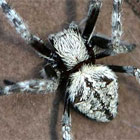
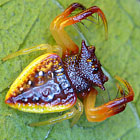
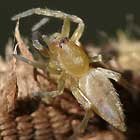
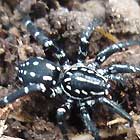
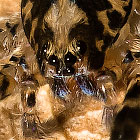
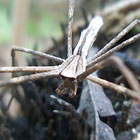
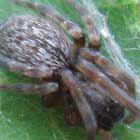
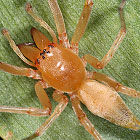
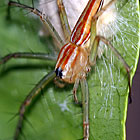
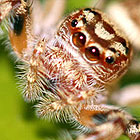
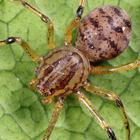
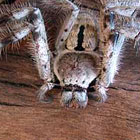
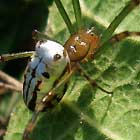
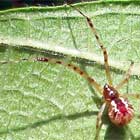
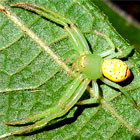
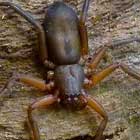
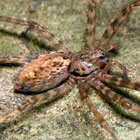
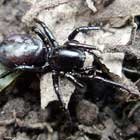
These observations made by Brodie Foster in the Mooloola Valley seem to establish that the subadult form of the male Opisthoncus mordax is very similar in appearance to the female of a common garden jumping spider, Opisthoncus parcedentatus. As the female for O. mordax has never been described, it seems likely that the male and female have been wrongly described as separate species instead of being described as the male and female of one species.
On the 27th of January 2010 Brodie observed a sub adult male jumping spider (resembling a greenish Opisthoncus parcedentatus) moulting into Opisthoncus mordax. Brodie observed this transformation again on the 7th of March 2010 and on the 15th of March 2010. The photos below show different views before the moult, just minutes after the moult and a few days after the moult once the colours have developed. There are many more photos of the adult in the page linked in the references below.
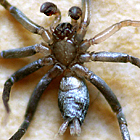
- Male subadult facing, 14 hours before the moult
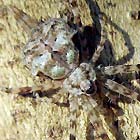
- Male subadult from above, 14 hours before the moult
- Male subadult facing, 12 hours before the moult
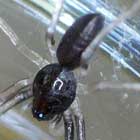
- Male subadult from side, 12 hours before the moult
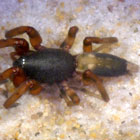
- Male adult facing, 15 minutes after moult
- Male adult, closeup from above, 15 minutes after the moult
- Male adult, 15 minutes after the moult
- Male adult facing, 10 days after moult
- Male adult, closeup from above, 10 days after the moult
- Male adult 10 days after the moult
- The adult with its previous exoskeleton moulting in its retreat
- References
Male subadult facing, 14 hours before the moult
The following photos show comparisons of the pre-moult with the post-moult of several specimens at various ages. They are an aggregation of a range of three separate specimens.

Male subadult from above, 14 hours before the moult

Male subadult facing, 12 hours before the moult

Male subadult from side, 12 hours before the moult

Male adult facing, 15 minutes after moult

Male adult, closeup from above, 15 minutes after the moult

Male adult, 15 minutes after the moult

Male adult facing, 10 days after moult

Male adult, closeup from above, 10 days after the moult

Male adult 10 days after the moult

The adult with its previous exoskeleton moulting in its retreat

References
There may be many species in the Opisthoncus parcedentatus group, the described species named by Koch in 1880. He described the male of Opisthoncus mordax in the same year. This discovery suggests that the missing female for Opisthoncus mordax may be one of the spiders in the Opisthoncus parcedentatus group. While the spiders we refer to as Opisthoncus parcedentatus (which may or may not be several species) are very common, the male has not been documented recently. No photograps or drawings of the male exist, to our knowledge. There is a drawing of the male palp of Opisthoncus parcedentatus in Davies and Zabka 1989 which strongly resembles the male palp shown here, possibly drawn from the holotype or paratypes collected for Koch. Davies and Zabka in 1989 mentioned that Opisthoncus is widespread in Australia with more than 20 described species. There are probably many more undescribed species. Some of them do not conform to their main grouping in the key, having both plurident and fissident species. Many like Opisthoncus mordax have large ventral or dorsal cheliceral teeth as well as teeth on either side of the fang groove.
- View Brodie Foster's page on Opisthoncus mordax moulting
- Opsithoncus mordax Koch 1880 Biting Jumping Spider - More pictures of male adults and subadults