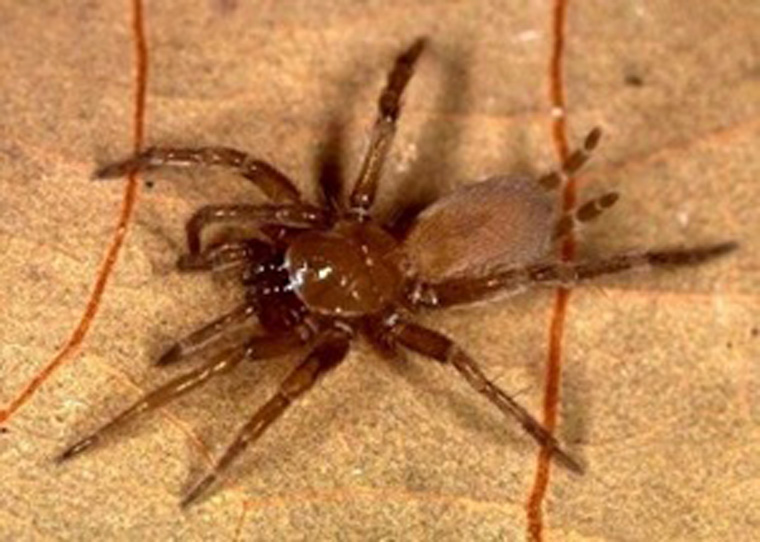
Most curtain web spiders are medium-sized, fast-moving spiders. Typically they are diagnosed by two long spinnerets. They produce delicate filmy silk around their retreats. The largest known is Australothele nambucca, body length 30mm, the smallest is the six-eyed Masteria toddae from the wet tropics, body length 6mm. They are found in most habitats from rainforest to grassland throughout Australia except Tasmania. The highest diversity is probably in eastern Queensland with two genera Namirea and Australothele. Namirea tends to be more common in open forest edges while Australothele is more common in moister areas and rainforest. These spiders opportunistically occupy spaces formed by cracks and crannies under logs, stones and among tree roots.
Australothele jamiesoni Rainforest Curtain-web Spider
The Rainforest Curtainweb Spider is medium sized Diplurid occupying riverine and subtropical rainforest. The filmy web is made in small to large natural spaces between rocks, under logs, identifiable to genus by the combination of web type and spinnerets. 
Namirea planipes Open-forest Curtain-web Spider
The Open-forest Curtain-web Spider likes habitat drier than another closely related Diplurid, Australothele jamesoni, but their ranges overlap. The females occupy a tangled irregular curtain web built under naturally occurring ledges of logs, stone or soil. The males wander during the...