Home - ARACHNE.ORG.AU

Astioids-other

This unsatisfying catch-all group is the surprising result of DNA work indicating many diverse genera with widely varying body types are more closely rated to each other than the spiders in the groups to which they had previously been assigned. Within Astioids-other are several subgroupings. One of them is a clade including Mopsus and Sandalodes, two genera displaying obvious similarities. Another is a large group with Opisthoncus, Trite, Holoplatys and probably Ocrisiona. Neon may or may not belong to this Astioids-other which in any case is a provisional grouping until more work is done. Other Astioids in better established subfamilies or groupings included the Myrmarachninae and the Astieae, are separated here under their own navigation. 'Breda' is here and not in the Marpissinae which contains the true Breda.

Trite longula

Evarcha sp.
The genitals suggest a relationship with Evarcha (flavocincta group), pers. comm. Jerzy Prószyński. This is where we are placing this Salticid... 

Holoplatys ultraflat

Holoplatys lhotskyi Zabka, 1991 Queensland Ultraflat
A small, extremely flat spider usually on or under bark. Males and females both variable in size, to about 6mm body length. The holotype (described specimen) was collected by Val Davies at her home in Fig Tree Pocket on 29 January 1973. It has been found in other areas of Brisbane, Queensland,... 

Holoplatys planissima

Holoplatys planissima (L. Koch, 1879) Grooved Jumping Spider
A medium-sized jumping spider usually on or under eucalypt bark in most parts of continental Australia from Western Australia to Queensland. Often... 

Holoplatys

Holoplatys sp Small Holopplatys
This small flat spider, a Holoplatys species, was collected at Freshwater National Park, the body length about 4mm.  

Spider

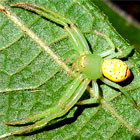
Mopsus mormon Karsch, 1878 Northern Green Jumping Spider
The genus Mopsus has only one spider - Mopsus mormon, previously Mopsus penicillatus. It is the largest Australian jumping spider, found throughout the warmer regions in the northern part of Australia down as far as Coffs Harbour. Green Jumping spiders are large, beautiful,... 

Ocrisiona leucocomis

Ocrisiona leucocomis (L. Koch, 1879) White-striped Ocrisiona
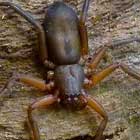
This widespread Salticid is a bark-dweller with a flat body, mostly black with a thin longitudinal line on the carapace and diffuse white markings in... 

Opisthoncus mordax

Opisthoncus mordax Koch 1880 Biting Jumping Spider
Attractive, large, and with an outgoing personality, the male Biting Jumping Spider is usually found hunting on shrubs in daylight. Shiny black to dark brown, the male is readily identifiable by its body type and colouration. It has a white to cream patch on the upper surface of rear, sloping part of the cephalothorax behind the posterior lateral eyes and a white to cream stripe running... 

Opisthoncus parcedentatus?

Opisthoncus mordax moulting from sub-adult O. parcedentatus type
These observations made by Brodie Foster in the Mooloola Valley seem to establish that the subadult form of the male Opisthoncus mordax is very similar in appearance to the female of a common garden jumping spider, Opisthoncus parcedentatus. As the female for O. mordax has never been described, it seems likely that the male and female have been wrongly described as separate... 

Spider

Opisthoncus parcedentatus L Koch 1880 Garden Jumping Spider)
Widespread and common, body length of females possibly to 15 mm, males to 12 mm, both usually smaller. Known from Queensland and NSW but probably will be found Australia wide including islands. The male may be currently known as Opisthoncus mordax. They are quite variable in appearance and... 

Opisthoncus polyphemus

Opisthoncus polyphemus (L. Koch, 1867) Cyclops Jumping Spider
A widespread and common medium-sized jumping spider, female body length 8-9 mm, the male 6-7 mm, in eucyalypt forest, heathland and woodland to dry rainforest in New Guinea, Queensland and New South Wales. The body is pale yellow-orange with white markings except for very obvious black circles... 

Opisthoncus sp

Opisthoncus sp (Big-jawed Jumping Spider)
A dramatic looking Jumping Spider with big jaws and fangs, similar to Opisthoncus mordax. Body length 9mm. This undescribed species is very likely to... 

Two-spotted Jumping spider

Opisthoncus sp (Two-spotted Jumping Spider)
This spider was 4mm body length in a retreat in a folded leaf of Cissus antarctica (Native Grape) beside the creek. Like many small jumping spiders of this type it has black tips on the ends of the tarsi or "feet". The cephalothorax has a "helmet" of dark in the region of the eye quadrangles. The... 

Opisthoncus sp

Opisthoncus sp cf O. parcedentatus
This Jumping spider female, body length about 8mm, has different teeth and epigynum to O. parcedentatus to which it may be closely related. Teeth however can be variable.  

Opisthoncus

Opisthoncus sp cf O. parcedentatus
A rather fat looking species either pregnant or naturally fat.  

Opisthoncus Grey Striped Bark Jumper

Opisthoncus sp Grey Striped Bark Jumper
A medium-sized jumper, body length around 8mm, found on grey bark in coastal areas in Queensland, particularly on Casuarinas. It has two dark stripes... 

Opisthoncus mooloola

Opisthoncus sp. Mooloolah
A medium sized jumping spider, common across South East Queensland in good natural habitat receiving plenty of rain, especially along waterways. The... 

Opisthoncus sp. North Queensland

Opisthoncus sp. North Queensland
A distinctive, medium-large, yet slender jumping spider close to Opisthoncus but not firmly placed in that genus. Body length of the male... 

Cytaea severa

Paraphilaeus daemeli (Keyserling, 1883) Daemel's Trite
This widespread and common, well camouflaged Salticid is usually found wandering on foliage in dry eucalypt scrub to rainforest margins, even grasslands, throughout coastal Queensland and NSW, possibly elsewhere. Well camouflaged. The body is a cryptic pattern of buff-cream to brown with patches... 

Sandalopes

Sandalodes bipenicillatus (Keyserling, 1882) Two-tufted Sandalodes
This attractive jumping spider is of medium size, female: 10 mm, male: 9 mm. Found on bark and green leaves. The male has two brushes of dark hairs that form forward-pointing horns on the sides of the spider's head, thus the species name. It was named in 1882 by Keyserling as Mopsus which it... 

Sandalodes scopifer

Sandalodes scopifer (Karsch, 1878) White-spotted Sandalodes
A rather large jumping spider, dark brown to black, throughout Australia and also known from New Guinea, often found on wattles and gums. Body... 

Sandalodes superbus

Sandalodes superbus (Karsch)
The largest and most robust species of Sandalodes, body length of females up to 12mm males up to 11mm. The male has cheliceral spurs (on the... 

Holoplatys sp?

Tara? cf anomala (Keyserling, 1882) Ergane? cf cognata L Koch, 1881 Scorpion Mimic
Body length males 3.2mm interesting for a number of features: small size, habitus and behaviour very scorpion like, extreme flatness, bulging femurs leg I, extremely strong-looking "crone-finger" fangs, with bumps and scoops, rather like Ergane cognata, or Tara anomala two slender... 


View My Stats